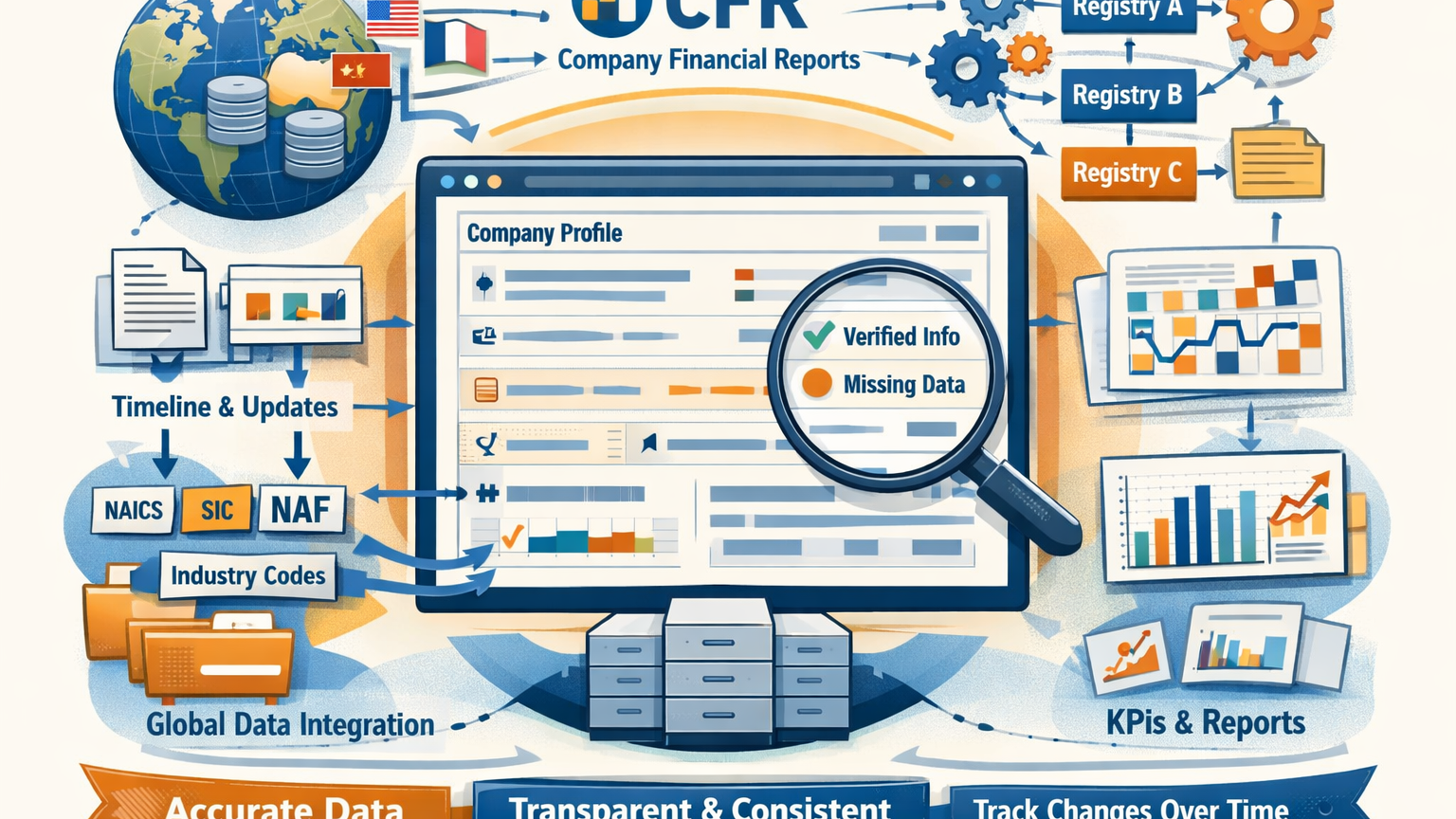
CFR (Company Financial Reports) is a platform built to turn real-world company data into structured, readable company profiles and reporting-ready views. Instead of relying on self-reported marketing descriptions, CFR focuses on signals that come from registries, official datasets, and country-specific sources, then organizes those signals into a consistent model that can scale across thousands (and eventually millions) of entities.
At its core, CFR is designed around a simple rule: company pages should be grounded in verifiable facts. That means a profile should reflect what is actually present in the dataset—legal identity fields, registry timestamps, administrative status, industry classification codes, and establishment history where available. When something isn’t available (for example financial statements for a specific jurisdiction or an employee range marked as unknown), CFR keeps the profile honest and explicit about what is missing rather than filling the gap with guesses.
A major challenge in company intelligence is inconsistency across countries. Different registries use different identifiers, different update cycles, and different industry classification systems. CFR treats this as a data engineering problem first: ingest what each country provides, preserve the original meaning, and then map it into a shared internal structure. That makes it possible to compare like-for-like concepts across jurisdictions while still respecting how each registry works in practice.
Industry classification is a good example. Many datasets attach codes (such as NAF/NAFRev2 in France or other national systems elsewhere) that represent the company’s main activity. CFR stores those codes, keeps the original label when it exists, and builds crosswalks to other code systems when possible. The result is that a company profile can show the classification as it appears in the official source and also support broader navigation by category as CFR expands coverage.
CFR is also built for time-awareness. Registries update over time, companies change activity codes, establishments open or close, and administrative states can shift. A reliable company profile should not look like a static brochure—it should behave more like a timeline. CFR therefore treats update dates and period counts as first-class data: they help explain when a profile was last processed, what part of the record changed most recently, and how much historical depth exists for that legal unit.
For users, the practical outcome is a set of pages that are useful in two ways: (1) as quick, readable summaries and (2) as structured data surfaces that can support deeper reporting. CFR is intentionally opinionated about this split. A profile page should be easy to scan, but it should also preserve the underlying structure so that financial report templates, KPI logic, and country-specific reporting formats can be layered on top when the data exists.
Because CFR is data-first, coverage varies by country and dataset availability. Some jurisdictions provide rich public records and structured financial filings; others provide only partial signals or identifiers. CFR’s approach is to expand country by country, keeping ingestion pipelines modular and traceable, and documenting what each country module can and cannot provide. This prevents the common trap of “one-size-fits-all” company pages that look complete but aren’t.
CFR also supports large-scale content generation in a controlled way. AI-generated text is only useful when it is constrained by the data it is allowed to use. CFR’s article generation is built around strict prompts that require the model to use provided fields, avoid inventing company-specific facts, and add only general explanatory context about registries and classifications. The goal is to produce readable narratives without compromising data integrity.
If you are exploring CFR, the best way to use it is to treat each page as a structured snapshot: what we know, what we do not know, and what the registry signals imply at a high level. As coverage expands, more country modules, datasets, and reporting views become available—while the same grounding principles remain: transparency, traceability, and consistency across scale.